“Mazala Dosa” isn’t just a brand. It’s a homecoming. Born from a hunger for recognition, raised on tradition, served with fire.
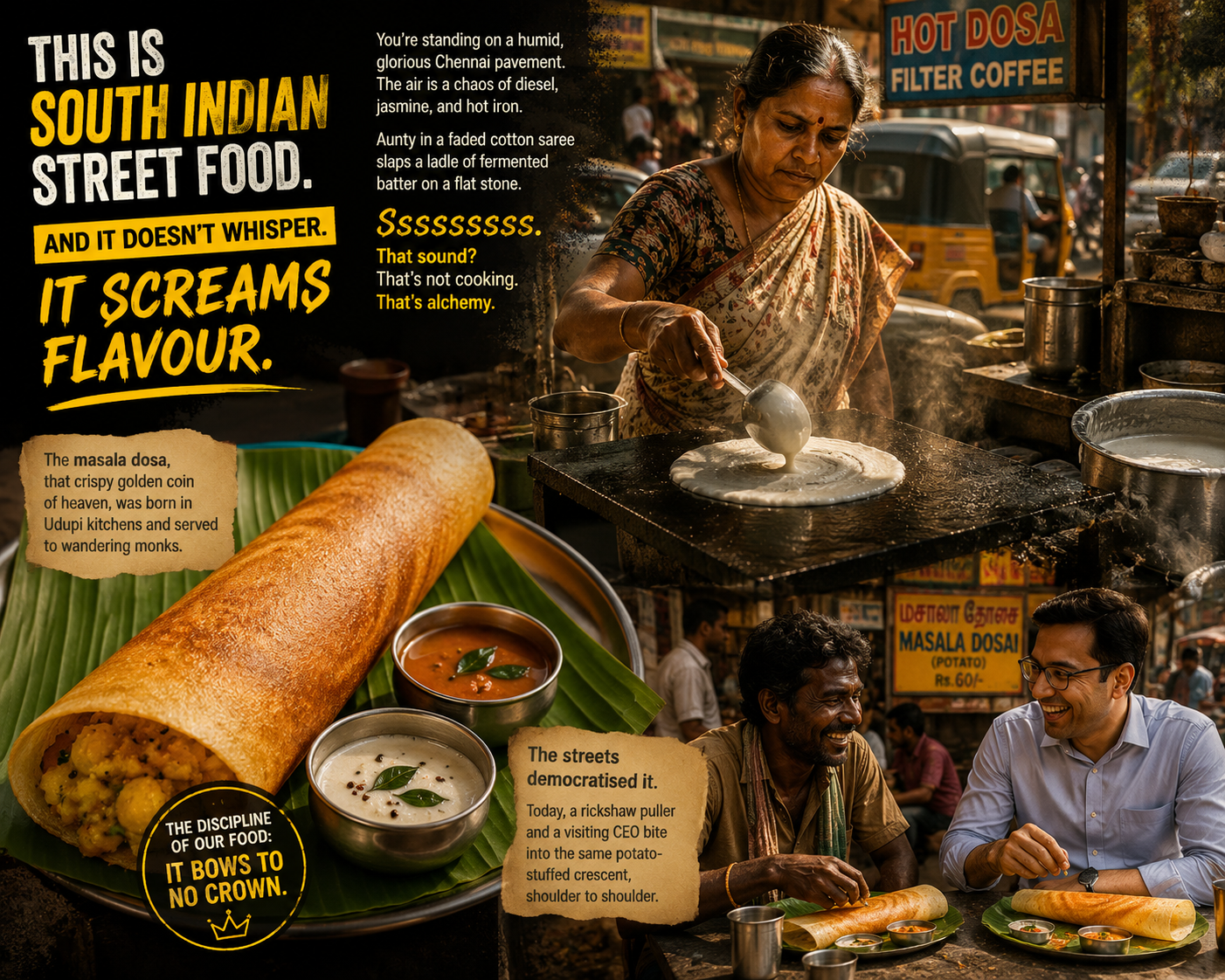
You’re standing on a humid, glorious Chennai pavement. The air is a chaos of diesel, jasmine, and hot iron. Aunty in a faded cotton saree slaps a ladle of fermented batter on a flat stone. Sssssssss. That sound? That’s not cooking. That’s alchemy.
This is South Indian street food. And it doesn’t whisper. It screams flavour.
Forget porcelain plates — here, a banana leaf is a throne. The masala dosa, that crispy golden coin of heaven, was born in Udupi kitchens and served to wandering monks. The streets democratised it. Today, a rickshaw puller and a visiting CEO bite into the same potato-stuffed crescent, shoulder to shoulder. This is the discipline of our food: it bows to no crown.
“Dosai” is older than half the world’s capitals. Rice and black gram soaked, ground by stone, left to breathe overnight. That tang isn’t a trick — it’s 18 hours of patience. It’s health, wrapped in a crunch.
Wheels squeaking, coconut chutney sloshing. 3 AM after a movie. This is where children learn spice, and grandparents sip filter coffee.
Don’t let the name fool you — a 24/7 temple of ghee. Benches shared by friends arguing over cricket, families tearing apart idlis, and lone office workers finding hospitality in a free extra sambar refill.
Crushed curry leaves, a pile of vadas. You just prayed. Now you crave. This is food as social glue — no one eats alone here.
Mazi here. Our founder, Omer Rahim, had a problem: outside India, the masala dosa is either unknown or wrong. No crackle. No soul. No story. Meanwhile, back home: farmers grow heirloom rice and black gram. Street aunties flip the perfect dosa — and stay invisible. An age-old tradition of fermentation, better than any gut-health fad, gets reduced to a “vegan option” on page 47 of a menu.
Nope.
So he did something crazy. He asked: what if we take this golden crescent — this king of street food — and walk it right into the mainstream? Not by shrinking it. Not by “modernising” it into a dry shell. But by celebrating everything it already is?
That’s why Mazala Dosa was born — to spread the rich history and real benefits of South Indian street food to every hungry soul on Earth. Not as exotic. Not as ethnic. As essential.
He’s eaten on plastic stools in Padmanabhapuram and white tablecloths in Paris. Flavour has no passport — but the dosa deserves the same stage as any pizza or taco.
This isn’t “street food” like a hot dog. This is Udupi temple fare, fed to monks, then kings, then rickshaw pullers. Every crisp edge holds a story.
Fermentation = gut health. Lentils = protein. Rice = energy. No refined flour, no hidden sugar, no deep-fried nonsense. Healthy by birth, not by marketing.
Underrepresented? Let’s end that. Today. Not to replace your food — to invite you to our table.
“I don’t just want you to eat a dosa. I want you to feel why my grandmother woke up at 4 AM to soak rice. I want you to taste the rain that fed the farmer’s field. I want you to understand: this is not fast food. This is slow love, folded into a cone.”
— Omer Rahim, Founder of Mazala Dosa
Because every component is a discipline — and we don’t cut a single corner.
Fermented like sourdough’s hotter cousin — rice and black gram, soaked, stone-ground, left to breathe for 18 hours.
Cumin, green chilli, turmeric, curry leaves, mustard seeds — tempered with a discipline that borders on meditation.
Liquid gold dripped precisely. No greed. No shyness. Just the gloss that finishes the crackle.
White coconut (cooling), red tomato (fiery), green coriander (herbal madness). And sambar — a lentil-vegetable stew that tastes like a hug from your rooted ancestor.
Crrrrrack. The sound of 18 hours of fermentation surrendering to a fingertip.
Potato and spice perfume. Pause for a second. Breathe it in. This is the part nobody photographs.
The chutney clings to every ridge. Coconut, tomato, coriander — pick your moment, pick your mood.
Crisp → Soft → Explosion. Whole-grain energy. Lentil protein. Curry-leaf antioxidants. Your gut microbes throw a party.
There is only one thing that answers: a Mazala Dosa. Crisp as a promise. Golden as a good memory. Stuffed with potato that tastes like home, served by hands that respect the origin.
It’s not just street food. It’s generations of craft, folded into a cone. Eaten with your fingers. Shared with a stranger who becomes family.
COME. EAT. UNDERSTAND.